
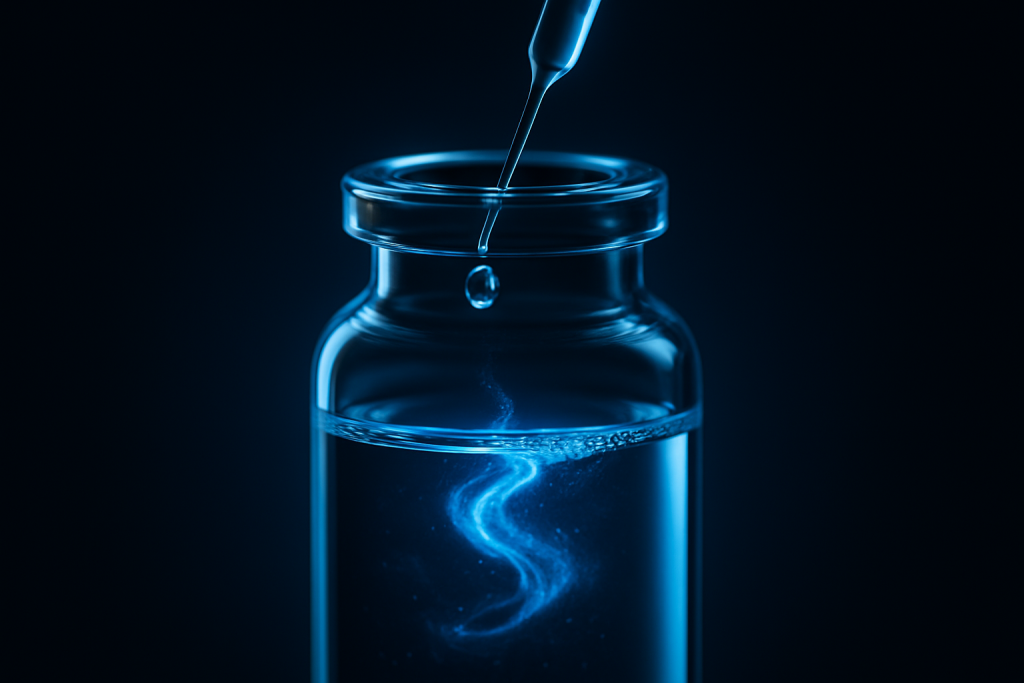
Lyophilized peptides must be dissolved — reconstituted — before they can be used in any research application. The process is simple, but doing it correctly preserves both purity and accuracy. This overview covers the why and the what; for a step-by-step bench procedure, see the Lab Handling Protocol guide.
Choosing a diluent
The most common diluent for multi-use research vials is bacteriostatic water — sterile water containing 0.9% benzyl alcohol, which inhibits microbial growth and allows a reconstituted vial to be used over several days. For single-use or specialized protocols, sterile water or sterile saline may be specified instead. The right choice depends on the compound and how long the solution will be kept.
Technique that protects the molecule
- Add water to the wall, not the cake. Direct the diluent slowly down the inside of the vial so it runs onto the powder gently rather than blasting it.
- Do not shake. Agitation can denature or aggregate sensitive peptides. Swirl the vial gently and let the compound dissolve on its own.
- Be patient. Most peptides go into solution within a few minutes. A fully clear solution with no visible particles indicates successful reconstitution.
Concentration is a choice
The concentration of your finished solution is set by how much diluent you add to a known mass of peptide. More water means a more dilute solution; less water means a more concentrated one. Because accuracy here determines the accuracy of everything downstream, it is worth calculating the volume deliberately — the Calculating Concentration and Volume guide works through the arithmetic with examples.
After reconstitution
Once dissolved, the peptide is in its least stable form. Refrigerate it, keep it out of light, and aliquot anything you will not use immediately so it can be frozen and thawed only once.