Purity is the single most important specification on a research peptide, and also the most widely misunderstood. A label that reads ‘99%’ is not a marketing slogan — it is a measurable claim that should be backed by data. This article explains what that number means, how it is measured, and what it does not tell you on its own.
What purity actually measures
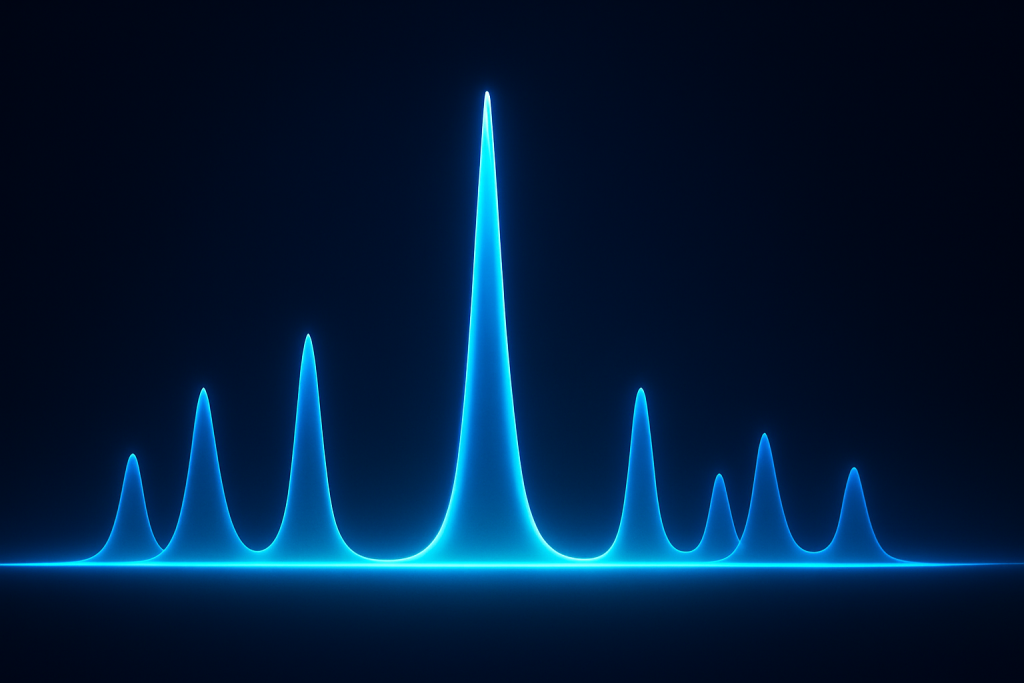
Peptide purity, as reported on a certificate of analysis, is the percentage of the target compound relative to all other peptide-related species in the sample. It is determined by High-Performance Liquid Chromatography (HPLC). In an HPLC run, the sample is pushed through a column that separates molecules by how strongly they interact with the column material. Each compound emerges at a characteristic time and registers as a peak.
The area under the main peak, divided by the total area of all peaks, gives the purity percentage. A 99% result means that 99% of the detected peptide material is the target molecule, with the remaining 1% being trace impurities.
Purity is not the same as identity
Here is the critical distinction: HPLC tells you how much of the dominant compound is present, but not what that compound is. A sample could be 99% pure and still be the wrong peptide. That is why purity is always paired with an identity test — typically mass spectrometry, which measures the molecule’s exact mass and confirms it matches the expected sequence. Purity without identity is only half the story.
Where impurities come from
- Truncated sequences — chains missing one or more amino acids from an incomplete synthesis step.
- Deletion or insertion products — sequences with the wrong number of residues.
- Oxidation or deamidation — small chemical modifications that can occur during synthesis or storage.
- Residual salts and solvents — addressed separately as net peptide content rather than chromatographic purity.
How to use the number
Treat the purity figure as a floor for your experiment’s reproducibility. For most research applications, ≥ 99% by HPLC, paired with a confirming mass spectrum, is the benchmark to look for. Always read the actual chromatogram on the certificate rather than trusting the headline figure alone.